
 The Westside of Los Angeles is a beautiful place to live. I am grateful for that. 2019 brings many of the challenges from 2018 with it, but also a number of positive developments.
I am honored to report my private psychotherapy practice in West Los Angeles, CA 90025 is FULL as I've received 10+ referrals since late December. I have started a waiting list but I continue to support individuals in linking to other certified Cognitive Behavioral Therapy practitioners, and other services most appropriate to their situation, in the area. My heart is full with appreciation to those reaching out for support. I fully recognize and connect with the privilege of supporting individuals during immense moments of vulnerability and honesty. I also grasp the tremendous disappointment in contacting someone in hopes of developing a therapeutic alliance and learning of their unavailability. This is why I think it is vital to post this update. I think the recent amount of referrals is reflective of the time of history we are in, the impact of our stressful and complicated lives, and the demonstrated inner strength, curiosity and empowerment of those reaching out. My hope is that it is also a symbol of decreased stigma in seeking out support for what each of us experiences in our respective journeys. I truly believe mental health symptoms are part of our unique humanity, and therefore the significance is not 'if' we are having challenges but 'how' we are attending to ourselves. May you keep pushing in 2019 for consistency, contentment and compassion in your support for yourself, loved ones, colleagues and acquaintances. I wish you success in your maintenance of the self-discipline and commitment required to continue your exercise, diet, relationship and routine goals. May we continue to replenish ourselves and radiate our emotional energy outwards to others. Here last year's New Year post. I still feel similar. If it's possible, maybe a bit more grateful -- https://goo.gl/BgMYPe
0 Comments
 Below I've included text from the article, "Why Cognitive Behavioral Therapy Is the Current Gold Standard in Psychotherapy."
This link is a recent research opinion article within the field of cognitive behavioral therapy and, to me, has a lot of diverse considerations and implications. I think the article highlights the importance of considering differences amongst providers -- certification, adherence to fidelity within treatment, resilience and more. But, even more important, I read this research as acknowledging where we are as a field. By accepting CBT's scientific basis, years of research and structured modality, I do not see it as diminishing or "throwing shade" at other modalities. There are a lot of skilled practitioners with diverse modalities within the psychotherapy field and most do important, passionate work. I think this truth will remains irregardless of background -- CBT, analytic, ISTDP, etc. -- or conceptualization of the human condition. Instead, I read this article as a consolidation of numerous scientific efforts within the field of psychology. CBT is not a panacea, but it's a good marker in our evolution in what we know works in therapy. As practitioners, let us continue to join together to improve our services for our clients, and remember that difference is NOT deviant. A few key highlights I found interesting: Cognitive behavioral therapy: "(1) ... is the most researched form of psychotherapy. (2) No other form of psychotherapy has been shown to be systematically superior to CBT; if there are systematic differences between psychotherapies, they typically favor CBT. (3) Moreover, the CBT theoretical models/mechanisms of change have been the most researched and are in line with the current mainstream paradigms of human mind and behavior (e.g., information processing)." However: "...there is clearly room for further improvement, both in terms of CBT’s efficacy/effectiveness and its underlying theories/mechanisms of change." and... "...although CBT is efficacious/effective, there is still room for improvement, as in many situations there are patients who do not respond to CBT and/or relapse. While many non-CBT psychotherapies have changed little in practice since their creation, CBT is an evolving psychotherapy based on research (i.e., a progressive research program). Therefore, we predict that continuous improvements in psychotherapy will derive from CBT, gradually moving the field toward an integrative scientific psychotherapy." Citation: David D, Cristea I and Hofmann SG (2018) Why Cognitive Behavioral Therapy Is the Current Gold Standard of Psychotherapy. Front. Psychiatry 9:4. doi: 10.3389/fpsyt.2018.00004 #cognitivebehavioraltherapy #cbt #psychotherapy #research #goldstandard
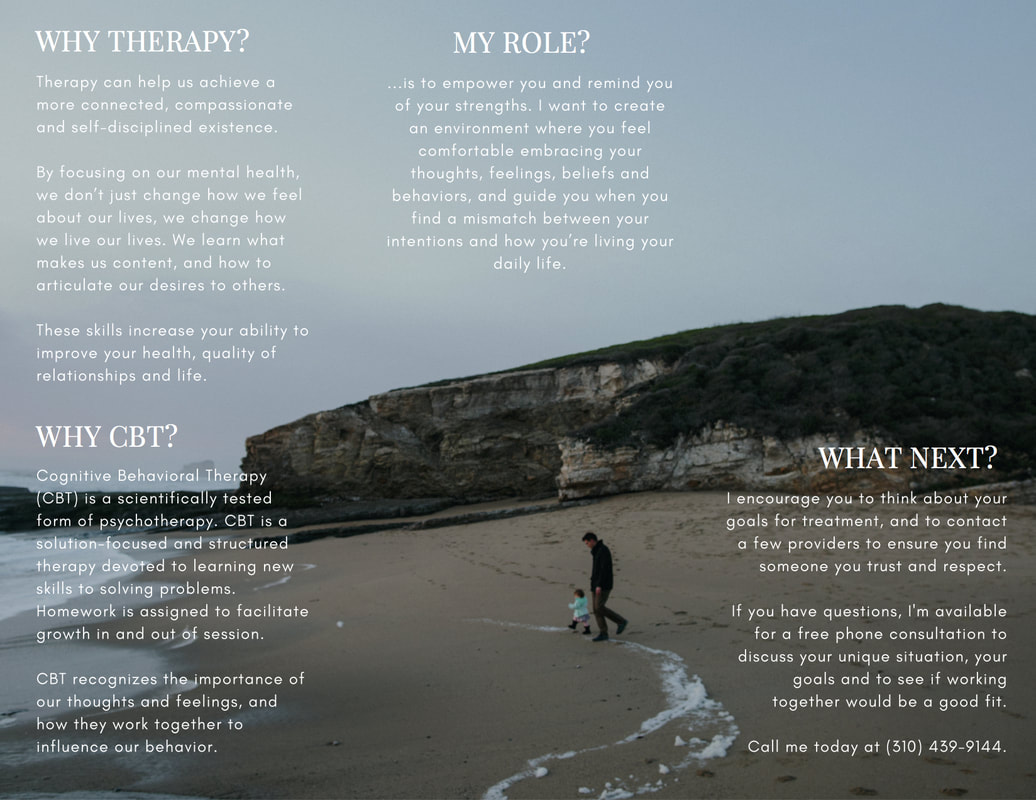
I'm excited to share my brand new private practice brochure! I just spent a few solid hours working with the amazing staff at FedEx to finish.
Fun cultural fact: If you Google, "to see if working together would be a good fit" with quotations, 90% of websites listed are from therapists. Apparently, we're the only ones who use that phrase. Learn more about my certified Cognitive Behavioral Therapy West Los Angeles psychotherapy practice. #therapy #therapist #westla #westlosangeles #90025 #cbt 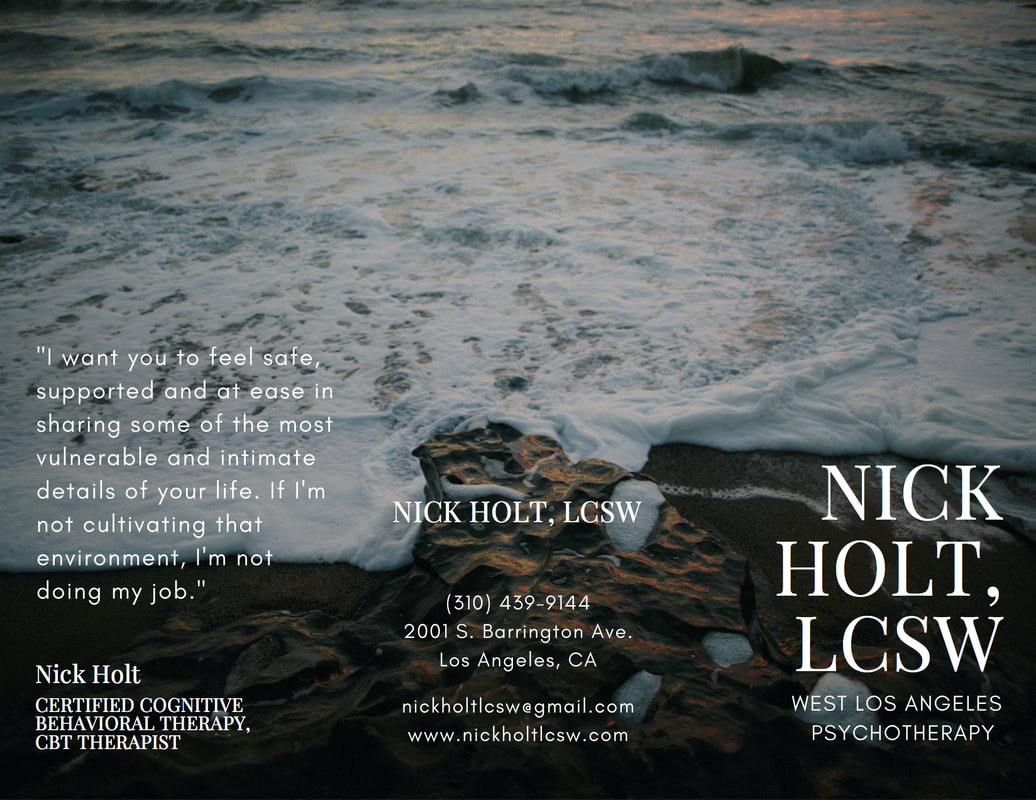
Raising a small child brings all sorts of challenges. Lately, I've found myself waking up early and preparing lunches. During these pre-dawn hours, I've fallen in love with a number of podcasts and listen to them regularly. As a certified Cognitive Behavioral Therapy, CBT therapist in West Los Angeles, I was highly impressed by Alix Spiegel and Lulu Miller's first episode of Invisibilia, "The Secret History of Thoughts". It was a compelling exploration of our thoughts and an interesting analysis of mental health's view of thoughts. The contrast of psychoanalysis, cognitive behavioral therapy and mindfulness and meditation was useful and relevant not only for people experiencing symptoms like depression or anxiety, but also a good reminder for me as a therapist. Check it out and let me know what you think.  This post was originally featured on WellnessUniverse.com.
I recently became a Diplomate in the Academy of Cognitive Therapy (ACT). The ACT is the only cognitive behavioral therapy (CBT) certifying agency in the world. Joining this elite group of therapists is quite an honor. There are many therapists in the world that can say they are CBT trained but only 750 people in the world can say that they are CBT certified. One of the greatest benefits of being an ACT Diplomate is joining their ListServ. Some of the most prestigious CBT therapists in the world are on this list and share their perspectives on a daily basis. Unfortunately, much of this information does not get outside this small network and the clients they work with. In a recent ACT ListServ email from Reid Wilson, Ph.D., Dr. Wilson shared some helpful videos about anxiety relating to his new book Stopping the Noise in Your Head. I thought the videos were fun and demonstrate important concepts in CBT. About Dr. Wilson: He has spent much of his 30+ year career providing free or inexpensive ways to help people combat anxiety and worry, and encouraging them to seek CBT services when appropriate. In promoting his new book, Stopping the Noise in Your Head, he released a free video series called Noise in Your Head, which follows a young woman, Susan, in her struggles with anxiety. Here are a few of the highlights from each video:
This post was originally featured on HuffingtonPost.com
Being an eager, determined, and active male within my personal and professional roles, I understand the inherent challenges when it comes to living and maintaining a balanced lifestyle. It is also a frequent complaint encountered within my role as a therapist working with men. These conversations often start off like this: "I'm functional. I have a good paying job, I'm dating, having sex, I'm happy. I'm close with my family and have quite a few close friends. I eat well, I exercise, take good care of my body, and I like myself. I maintain an active lifestyle and seek out new opportunities for growth and personal development. There's nothing wrong with me, so why should I consider seeing a therapist?" There are many ways to answer this question. For the purposes of this article, I focus on two responses. 1) Few of us fall into this ideal on a consistent basis. Yes, fundamentally and cognitively, we know exercise, diet and nutrition contribute to better mental states. That nature provides us the opportunity to connect with our spirituality, to rejuvenate, and relax. We know giving back to society, mentorship and volunteering reap deep intrinsic rewards. We understand management of stress is vital, and to do so, we need to carve out time to play, be creative and relax. We've heard the importance of healthy and intimate relationships; of the benefits afforded to processing and exploring recent events and stress. But really, who has time to do this?!? Too often, we have competing interests in our day-to-day lives. With pressures coming from employment, peers, family, household chores and more, our daily tasks often become hasty, triaged decisions based in reaction rather than prevention. This makes sense. The Organization for Economic Cooperation and Development (OECD) is a forum where member countries discuss issues and policies relating to economic growth, prosperity and sustainable development. The OECD reports people in the United States of America (USA) work more hours per year, and have more employees working "very long hours" than the average nation. Collectively, the USA ranks 33rd out of 36 nations when it comes to "time devoted to personal care and leisure," an outcome which contributes to poor physical and mental health. Furthermore, our society reinforces a minimized view of such therapeutic activities and encourages other means of support instead. Roger Walsh states, "(these activities) require considerable and sustained effort, and many (individuals) feel unable or unwilling to tackle them. (Individuals) often have little social support, little understanding of causal lifestyle factors, and a passive expectation that healing comes from an outside authority or a pill." He identifies advertising as a main method of refocusing us onto more economic, and easier, ways of soothing these desires. These mechanisms include "self-medicating" via alcohol, nicotine, unhealthy food and other compulsions, which, at a certain point, become unhealthy and suffer from the psychological concept of habituation, the perceived benefits yielding less and less relief over time. These societal messages are further reinforced by many of our friends, family, employers, co-workers and many others. What can we do? Stress exists in all of our lives. It is not a question of if we will experience stress, but rather how we will deal with it. My colleague Ken Howard, LCSW recently listedsome warning signs when it comes to your lifestyle. Here's what I think: 2) Seeing a therapist can be helpful in moving from reaction-based decision-making to a more proactive approach. In doing so, we create an environment for preventative health care and move toward a more balanced lifestyle. Like seeing a doctor for regular check ups and evaluations, seeing a trained mental health professional on a regular basis can be a great way to maintain consistency in perceiving, evaluating, interpreting and responding to the overwhelming complexity making up our daily lives. In fact, with many mental health symptoms seen in primary care physician settings, there is a push within the field to integrate mental health treatment earlier and more often in physical health treatment as well. Very few of us are allowed the conversational space required to explore the deep cognitive and emotional impact of our daily lives, not only on our minds but also on our bodies. Now what? Given the challenges outlined by Walsh, being proactive over your lifestyle is imperative. In order to move toward a more proactive view of your lifestyle and healthcare, I believe integrating mental health treatment or coaching into one's schedule is vital. Prior to a mental health evaluation, it is important to have specific goals in mind. For example, if you are stuck, one goal could be to gain clarity. Other helpful hints in searching out a therapist include interviewing your therapist to ensure they are competent in approaching your unique situation (some great sample questions here), and to establish mutually agreed upon goals prior to beginning treatment. There are exceptional treatment protocols in the field of mental health including resolving uncertainty via Motivational Interviewing and Cognitive Behavioral Therapy, as discussed in my last post. |
Nick HoltMental Health and Therapy Writer. As featured on Huffington Post, Vox Media and elsewhere. Archives
January 2019
Categories
All
|
 RSS Feed
LOCATION*Barrington & La Grange in
West Los Angeles* |
© 2015-2018 Nick Holt, LCSW, BCD. ALL RIGHTS RESERVED.
|