
 The Westside of Los Angeles is a beautiful place to live. I am grateful for that. 2019 brings many of the challenges from 2018 with it, but also a number of positive developments.
I am honored to report my private psychotherapy practice in West Los Angeles, CA 90025 is FULL as I've received 10+ referrals since late December. I have started a waiting list but I continue to support individuals in linking to other certified Cognitive Behavioral Therapy practitioners, and other services most appropriate to their situation, in the area. My heart is full with appreciation to those reaching out for support. I fully recognize and connect with the privilege of supporting individuals during immense moments of vulnerability and honesty. I also grasp the tremendous disappointment in contacting someone in hopes of developing a therapeutic alliance and learning of their unavailability. This is why I think it is vital to post this update. I think the recent amount of referrals is reflective of the time of history we are in, the impact of our stressful and complicated lives, and the demonstrated inner strength, curiosity and empowerment of those reaching out. My hope is that it is also a symbol of decreased stigma in seeking out support for what each of us experiences in our respective journeys. I truly believe mental health symptoms are part of our unique humanity, and therefore the significance is not 'if' we are having challenges but 'how' we are attending to ourselves. May you keep pushing in 2019 for consistency, contentment and compassion in your support for yourself, loved ones, colleagues and acquaintances. I wish you success in your maintenance of the self-discipline and commitment required to continue your exercise, diet, relationship and routine goals. May we continue to replenish ourselves and radiate our emotional energy outwards to others. Here last year's New Year post. I still feel similar. If it's possible, maybe a bit more grateful -- https://goo.gl/BgMYPe
0 Comments
I am honored to have been accepted into the American Board of Examiners in Clinical Social Work (ABECSW) as a Board Certified Diplomate (BCD) as of September 27th, 2018. According to the ABECSW, the BCD is: The Board Certified Diplomate in Clinical Social Work (BCD) certification is a national hallmark of quality practice, recognized by insurers, professionals, healthcare companies, courts, and consumers. The BCD is issued by the American Board of Examiners (ABE) to those who can demonstrate their ability to practice advanced-generalist clinical social work at a high level of competency. 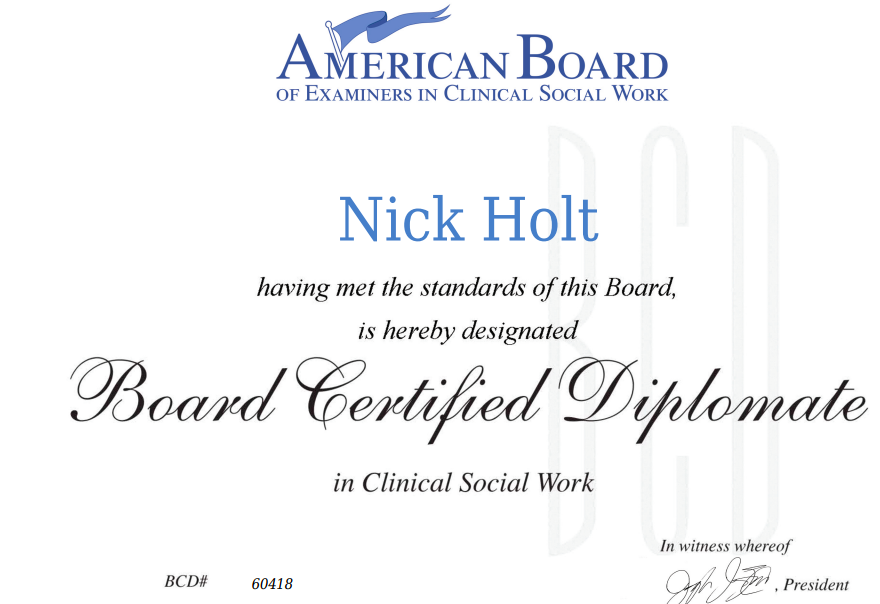 Nick Holt, LCSW, BCD provides psychotherapy in West Los Angeles, CA 90025 #psychotherapy #psychotherapist #westlosangeles #lcsw #boardcertifieddiplomate #bcd

R.I.P. to the Dearly Departed. Your Shadow Will Always Cast Down Upon Us
The recent celebrity suicides have hit me pretty hard especially as someone who has lost to suicide.
I connect to those left behind. When we have losses like this, for me, suicide loss acts as a cheese grater on my soul, slowly peeling back my own layers of grief. I imagine what those left behind face and are enduring, and, no matter how hard I try to forget, the losses always bring back memories, thoughts and feelings of those I've loved and lost to suicide. In my time at Didi Hirsch's Suicide Prevention Hotline, I remember staff would talk about call volume spiking, and the need for more counselors to come in to support the many callers who connected to the recent celebrity suicides. These deaths, and the media coverage of the events, always reminds us of our own and others pain. If you are someone who is struggling with suicidal thoughts, depression or has lost someone to suicide, this will be a difficult time. Please treat yourself well. Reach out to a friend, a loved one. Take that walk or extra time in the gym. Be gentle and kind to one another. It is a good time to invest in ourselves. If you need additional supports, I've included the below from my depression and suicide webpage as a reminder of resources for you during this difficult time. If you are struggling with thoughts of suicide or planning to kill yourself, PLEASE take a moment, a breath and remember that if you can delay suicidal impulse, research shows the impulses WILL decrease. There are some incredible volunteers and paid staff that would love to talk with you about what you are struggling with. Please reach out to the National Suicide Prevention Hotline (1-800-273-8255). From my website: Losing a loved one, family member, friend or even an acquaintance can be devastating. The feelings are complex, the thoughts overwhelming. Everything seems to trigger memories of the person gone, and all memories seem tainted by the nature of death. The process of losing someone can make us feel alone. Grief, loss and bereavement are incredibly difficult things to experience, but there are many amazing people and organizations out there for support: American Foundation for Suicide Prevention's I've Lost Someone American Association of Suicidology's Suicide Loss Survivors West Los Angeles-based Didi Hirsch's Survivors After Suicide are great places to start. #suicide #prevention #call #celebrity #support #suicidal #ideation #intent #empathy #love #connection
I had the immense pleasure of catching Dr. Susan David on Mental Illness Happy Hour "Judging Our Feelings" this past week.
She has a wonderful conversation with Paul -- starting at 21 minutes -- about thoughts, feelings and ways of approaching a healthier, more consistent lifestyle. She touches on many vital concepts, which are emerging with greater and greater scientific support. 
Dare I say the podcast was ALMOST as beautiful as this photo?
Two key concepts and reminders I took away from the podcast:
Have you listened to this podcast already? If so, what were some of your takeaways? So many beautiful possibilities in this chat. I highly recommend it. #thoughts #feelings #mentalhealth #support #love #compassion #beauty 
Given recent violent events, the tenor of political discourse and the deep divide within our country, I've been searching for a way to better understand what is going on and how to move forward personally and professionally.
I recently came across an article called "Can We Have Compassion for the Angry?" by Laura L. Hayes, Ph.D on Slate.com from 2016. I love how she differentiates amongst people who are struggling with mental health issues and people with anger issues. I also think it is important to highlight the link between unregulated anger and rage, and the connection to violence. I've had my share of rageful "conversations" on Facebook, and I find it incredibly helpful to remember that the true issue in play is anger. Unregulated anger and rage is a major issue in our society and one, I believe, few people consider as an significant issue. According to Dr. Hayes: "An adult who is able to effectively regulate anger uses it to alert himself to a problem situation. Managed well, it is an extraordinarily effective warning system. Unregulated, impulses are stronger, and thinking is less clear. The poorly regulated adult with enhanced reactivity, impulsivity, and a constant state of fight or flight sees in every interaction the potential for being harmed and the necessity to defend himself. The angrier he feels, the less clearly he will think. His reactions will often be out of proportion to the situation, and he will be prone to violence. Because he sees the world as a constant source of danger, he externalizes blame, to his spouse, children, neighbors, government, and 'others' in race, nationality, religion, or culture. Angry, blaming, aggressive, and unable to modulate his emotions, he can become a danger to others." and "Violent crimes are committed by people who lack the ability to regulate and modulate their response to perceived danger. This is not a hypothesis; it is a fact. The individual who lacks the essential skill of using more sophisticated reasoning, perspective-taking, and emotional stabilization to regulate his more primitive fear and aggressive impulses will fall into the pattern of aggressive overreaction again and again, often with escalating levels of violence. In the end, it is helpful for me to remember that these reflections are just thoughts and feelings we have about ourselves, others and the world. Our brain, self-empowerment and discipline are much stronger, more resilient and adaptable to change, and more powerful than our automatic thoughts and emotional reactions. We are able to change our responses to these provocations. Dr. Hayes recommends mindfulness as a tool to self-soothe: The process of mindfulness is often described as nonjudgmentally bringing awareness to the present moment. One can be mindful about an infinite number of things, so there are many ways to approach it. Often instruction begins with exercises of breath and/or attention to what is happening in the present moment in the mind and body.
For me personally, the next time I see Facebook's algorithm throw me a contentious political or religious dead-end dialogue doomed to fail, I'm going to conduct a quick breathing exercise and throw the below meme onto the discussion:

#anger #rage #issues #mindfulness #thinking #thoughts #reframe #deflection
 Below I've included text from the article, "Why Cognitive Behavioral Therapy Is the Current Gold Standard in Psychotherapy."
This link is a recent research opinion article within the field of cognitive behavioral therapy and, to me, has a lot of diverse considerations and implications. I think the article highlights the importance of considering differences amongst providers -- certification, adherence to fidelity within treatment, resilience and more. But, even more important, I read this research as acknowledging where we are as a field. By accepting CBT's scientific basis, years of research and structured modality, I do not see it as diminishing or "throwing shade" at other modalities. There are a lot of skilled practitioners with diverse modalities within the psychotherapy field and most do important, passionate work. I think this truth will remains irregardless of background -- CBT, analytic, ISTDP, etc. -- or conceptualization of the human condition. Instead, I read this article as a consolidation of numerous scientific efforts within the field of psychology. CBT is not a panacea, but it's a good marker in our evolution in what we know works in therapy. As practitioners, let us continue to join together to improve our services for our clients, and remember that difference is NOT deviant. A few key highlights I found interesting: Cognitive behavioral therapy: "(1) ... is the most researched form of psychotherapy. (2) No other form of psychotherapy has been shown to be systematically superior to CBT; if there are systematic differences between psychotherapies, they typically favor CBT. (3) Moreover, the CBT theoretical models/mechanisms of change have been the most researched and are in line with the current mainstream paradigms of human mind and behavior (e.g., information processing)." However: "...there is clearly room for further improvement, both in terms of CBT’s efficacy/effectiveness and its underlying theories/mechanisms of change." and... "...although CBT is efficacious/effective, there is still room for improvement, as in many situations there are patients who do not respond to CBT and/or relapse. While many non-CBT psychotherapies have changed little in practice since their creation, CBT is an evolving psychotherapy based on research (i.e., a progressive research program). Therefore, we predict that continuous improvements in psychotherapy will derive from CBT, gradually moving the field toward an integrative scientific psychotherapy." Citation: David D, Cristea I and Hofmann SG (2018) Why Cognitive Behavioral Therapy Is the Current Gold Standard of Psychotherapy. Front. Psychiatry 9:4. doi: 10.3389/fpsyt.2018.00004 #cognitivebehavioraltherapy #cbt #psychotherapy #research #goldstandard (Post originally featured on Rodale's Organic Life. Now found here.)
I'm honored to have been featured! 8 Little Ways To Build Mental Strength Every Single Day By Shelby Deering Simple steps to becoming a more resilient, mentally tough person. You don’t have to be the Dalai Lama or Oprah to achieve mental clarity and toughness. With some practice and armed with tips and tricks, you can find mental strength and in turn, improve your thinking patterns. We asked a gamut of mental health pros—a therapist, a mindfulness coach, and an Olympian—to weigh in on what methods lead to better mental strength. They all have gone on personal journeys to discover their own mental toughness. Nick Holt, LCSW, a certified cognitive behavioral therapist, shares that he is a “professional and personal survivor of suicide,” facing substance abuse and mental health challenges since he was a child. Lara Jaye, CEO of Lara Jaye LLC, is an author, speaker, and mindfulness expert who once dealt with depression, a marriage that was falling apart, and substantial health issues. Joanna Zeiger, PhD, is a professional triathlete and Olympian who says that she’s not a “natural” and lived an athlete’s life littered with injuries and unmet goals. What do these three have in common? They dug deep and uncovered grit and determination to reach their versions of mental strength. Here are 8 practices you can start doing today to build up your own. Increase Your Awareness Of Your Thoughts Mental strength is important, says Holt, because “the world is full of uncertainty, change, and negativity.” “In empowering ourselves to have a more connected, disciplined, and resilient existence, we increase the likelihood of having more contentment, support, and intimacy in our lives,” he says. And all that mental strength often starts with something that is equal parts simple and challenging—awareness. “Personally, it’s taken me a long time to connect to many of my thoughts and feelings,” Holt says. “For the majority of my life, many of my thoughts and feelings passed by without much attention. They were fused into my daily behavior. These thoughts and feelings guided my life without much consideration of the validity or usefulness of them.” Now Holt harnesses their power by observing his own life experiences, especially when negative situations occur. “As you enter this new level of connectedness to yourself, your thoughts, and your body, you enter a path of improving your confidence and self-esteem. You become more disciplined, experience more comfort within discomfort, and ultimately, become more mentally tough,” says Holt. (Here’s how to quit your negative thinking once and for all.) Jaye believes that awareness starts by “silencing the mind chatter.” She says, “Become aware of the radio station that is running in the background. How are you talking to yourself? What do you really believe about yourself? Journal your thoughts. Practice Visualization Visualization is a technique commonly applied by athletes, something that Zeiger writes about in her book, The Champion Mindset. But it’s a method that’s not limited to athletes. “I cannot emphasize enough the importance of visualization,” she says. “Visualization is an opportunity to mentally practice a situation so when the situation arises you are ready to conquer it. Most of the time, people use visualization to imagine perfect scenarios. In sports, it would be the perfect race, and in business, it could be closing an important deal and going over the conversations and actions that would lead to the deal being made. These types of visualizations, where everything occurs smoothly, are important rehearsals that can instill confidence.” She adds that visualization can result in mental preparedness for whatever may happen, saying, “Most situations in life do not go smoothly. So, imagery during visualization does not only have to be just about success, but also how to handle glitches. I call these ‘disaster scenarios.’ At some point, disaster will strike, and you will be empowered through your imaginary practice to figure out how to navigate the difficulty.” Jaye practices visualization every morning, setting her alarm a half hour before she needs to get up for the day. “I use that time to focus on what I am grateful for in my life, and then I do a 15-minute meditation focusing on my ideal outcome of some specific situation, including how I will feel when it happens. Sometimes I’m creating my life five years down the road, other times, I’m seeing my next speaking gig and what I’m communicating to the audience. Sometimes I’m envisioning myself happy, healthy, and fit, living on a warm beach. Every morning, it resets my mind and body to remember my goal and to feel what it will feel like when it arrives,” says Jaye. Employ Positive Self-Talk Positive self-talk is the thing that overtakes those negative thoughts when they creep in. Zeiger explains that when athletes endure long races, there are always rough patches that can easily lead to negative self-talk. “Athletes tell themselves things like, ‘I suck,’ or ‘I should just quit.’” Anyone can experience similar thoughts, even if they’re not in the middle of a race. Negativity can surface when you’re sitting in traffic, having a disagreement with a partner, or facing a health crisis. “Positive phrases during these times, [such as] ‘This will pass’ and ‘I am a warrior’ will help alleviate the burden of the tough patch,” says Zeiger. “Every day, we are confronted with situations that can cause angst. The way we react will dictate the ability to move forward quickly. Our thoughts are powerful and can change our mood quickly from positive to negative or from negative to positive.” Come Up With A Mantra And Use It Often Once you’ve mastered the art of positive self-talk, pick a mantra for yourself and use it often, says Zeiger. It can be a favorite quote or a personal phrase that you’ve devised that just feels right when you say it to yourself. Having a mantra naturally arise in your thoughts will no doubt take some practice and patience. Zeiger says, “Practice mental toughness. Just because you want to be mentally tough doesn’t mean you will be mentally tough. It takes a lot of practice.” Be Mindful And Engage All Your Senses Mindfulness is also something that can lead to more self-awareness. Jaye separates mindfulness from meditation, saying, “People often use meditation and mindfulness interchangeably, but they are different. Meditation is a way to practice being mindful. It’s to engage in contemplation or reflection.” Jaye recommends using meditation as a way to become more mindful, alongside deep breathing, yoga, walking, spending time in nature, dancing, and eating. “Mindfulness is the basic human ability to be fully present, aware of where we are and what we’re doing, and not overly reactive or overwhelmed by what’s going on around us,” says Jaye. “To become mindful, you can bring all five senses into whatever you are doing in the present moment.” That means allowing yourself to fully taste your food, slowing down to feel a warm breeze, or quite literally stopping to smell the roses. Prioritize Self-Care And Quiet Time Peaceful moments infused with self-care rituals can help you recharge your batteries so you can practice mental toughness the next day. Holt says to practice self-care and self-compassion “daily.” Holt adds that self-compassion can only be experienced once we choose to be vulnerable. “Vulnerability is the portal that can lead to an appreciation of acknowledgment, empathy, compassion, nurturance, self-care, and much, much more,” Holt says. Zeiger knows that even athletes need to power down. She says, “Mental toughness is not just about ‘going hard.’ It’s also about knowing when to fold your cards.” And she says not to judge yourself when you need a mental break. Jaye is an advocate for using silence to get in touch with your true feelings and thoughts. “Be still. Take that quiet time each day to reflect, offer gratitude, meditate, and become mindful of the present moment without judging it,” she says. Don’t Be Afraid To Experience Emotions Emotions can undoubtedly be scary at times. None of us really want to face our confidence issues or the unhappiness we experience with a spouse. But Jaye says that it’s essential to feel all those emotions as they come up so you can begin to harness the mental strength you’re thirsting for. “Stop numbing yourself,” she says. “Welcome the emotions and thoughts. Allow your body to feel.” Jaye also recommends using something called the RAIN Method when you become overwhelmed with emotions. R: Recognize what you’re experiencing and thinking A: Accept your emotions I: Investigate these thoughts and emotions N: Non-judgement of thoughts and emotions “Just allow [the emotions] to pass naturally, because what we resist persists,” says Jaye. Remove Yourself From Negative Situations And if all else fails and mental toughness seems out of reach, it might be time to simply remove yourself from any negative people, places, or situations that weaken you or affect your thoughts. Jaye says, “Notice the people and circumstances that are triggering you. Become aware and journal your thoughts.” In this same spirit, Holt says that it’s key “deepen your commitment to yourself and the people who make you feel good.” “It is hard to be mentally tough if you are doing something you dislike,” Zeiger points out. “If you are stuck in a situation where you are unhappy or hate what you are doing, if at all possible, remove yourself from that situation into something more likable. If it is not possible—for example, you are stuck in a job you dislike and cannot move—make a list of the positives and focus on that rather than the negatives.” Because at the end of the day, that is the foundation of mental strength. Focus on the positives, cast the negatives aside, and fixate on being the very best version of yourself. #anxiety #tools #techniques #cognitivebehavioraltherapy #cbt 
2018: New Year, New Appreciations. Let's reflect on all the beauty of our past year.
For me, the end of the year is a time of reflection, appreciation and gratitude. It's when I carve out time to be proud of myself and my accomplishments of the year. It's when family rejoins, and tradition and ritual come to a focus. During this process of reflection, I find it natural to reflect on areas for growth, development and change.
However, over the years as I've progressed through my experience as a certified Cognitive Behavioral Therapy, CBT therapist in West LA, I've noticed difficulty in executing some of the New Year's goals I set for myself. I know I am not alone in this. Much has been written about the importance of setting SMART (Specific, Measurable, Attainable, Relevant and Time-bound) goals. In thinking about my past goals and in remembering discussions with friends and family, identifying goals is rarely the main barrier. Too often I think our year-end reflections get filtered through a negative filter. Instead of dwelling on my accomplishments and successes, I tend to set goals that tap into my perceived inadequacies and dissatisfactions over the past year. Sadly, the outcome of this type of filtration is that I leave myself with a sense that I am, and/or my life, just isn't good enough. Goals of this nature can become a checklist of tasks I "need" to or "must" do, and become a basis for my own feelings of inadequacy, lack of confidence and esteem, and tend to gain momentum throughout the year. Conducted through this lens, in the generation of goals, I struggle to finalize a thorough list of SMART goals and commit to executing them. 
So much inspiration to be found in Los Angeles, CA.
If you are someone who is able to carve out SMART goals for yourself, hold yourself accountable throughout the year and move forward in creating your ideal self and environment without distress, BRAVO! Keep up the excellent work!
However, if you find yourself struggling to set SMART goals or executing change within your life, I have a proposal for you. In a prior post, I recommended: We all drift from our good-enough selves. Being adaptable, resilient and committing time to reconnecting with our passions, purpose and cultivating a process to do so is most important.
Similar to the above quote, it is important to remember that we all drift from our true intentions and goals -- each and every one of us. Therefore, it is not helpful to berate ourselves for this sort of drift.
It has been much more helpful to think about the times in my life when I have lived according to my desired goals -- going to the gym on a regular basis, cultivating meaningful relationships, treating loved ones in a loving, compassionate manner -- and reflecting on how I was feeling at those times, what I was thinking in those moments and factors that led to drifting away from those ideal behaviors. Typically, I find that when I cultivate such compassion for myself, I'm in a much better position to share compassion and nurturance with the world and others. If you are interested in working on your goals in 2018 and think a therapist might be helpful in keeping you on track, please contact my West Los Angeles psychotherapy practice today for a consultation. #goals #newyear #change #psychology #inspire #reflection I believe being in an intimate, connected and committed relationship is one of the most difficult things to do on the planet. Divorce rates in California have been estimated to be as high as 60%. In my Master's in Social Work coursework at University of Southern California, one of my favorite courses was Couples Therapy -- the interplay of seen and unseen dynamics, complexity of internal and external factors on the relationship, historical intimate relationships playing out in the present. Relationships are as fascinating as they are challenging.  One of the biggest challenges in my own marriage has been cultivating a shared story that carves a path of true North. Esther Perel's Where Shall We Begin has been incredibly helpful in seeing my marriage, and all of my intimate relationships, differently. I think her ability to highlight the shared stories of humanity and relationship are so calming and reassuring, they bring us to a place of sameness, safety and support. From NPR, quote is specific to her new book on infidelity: When you pick a partner, you pick a story, and that story becomes the life you live. ... And sometimes you realize, after years of living those parts of you, that there are other parts of you that have virtually disappeared. The woman disappeared behind the mother. The man disappeared behind the caregiver. The sensual person disappeared behind the responsible person. I highly recommend listening to Perel's podcast as a portal to seeing you and your relationship differently. As an entry into the podcasts, as a self-defined heterosexual, hypermasculine male, I found Season One, Episode Five and Season One, Episode Seven to be most relevant.
Happy listening! Learn more about my Cognitive Behavioral Therapy psychotherapy practice. #couples #therapy #masculinity #relationships #intimacy #love #support #psychotherapy #psychotherapist 
I love thinking the majority of my thoughts are worthless without action. That I am an observer of, not subjected to, the electrical storm within my mind. A growing gale nurtured through my focus and attention.
I love thinking I can choose to engage and ignore my thoughts -- to give life to my deepest passion and exile my darkest anxiety. These are things I focus on within my West Los Angeles psychotherapy practice. "...5% of our thoughts are actually meaningful and relevant..." What an empowering reminder. Here are a few of my favorite quotes from the Forbes article "A Better Way to Deal With The Negative Thoughts In My Head." Shannon Kolakowski, PsyD notes: “Defusion is the process of noticing your negative or anxious thoughts, such as ‘I'm going to be alone forever,’ and then responding to it with openness and curiosity as a distant observer,” says Kolakowski. “Rather than accept your thought as the ultimate truth, you recognize that thoughts will come and go, but you don't have to believe them or act on them. You become an observer, saying to yourself ‘I'm having the thought that I'm going to be alone forever,’ and then try to explore that thought with curiosity." “Creating a new relationship with your thoughts is freeing,” says Kolakowski. “You may not be able to control what thoughts pop up, but you can control how you respond to them. And you can control what action you take." Ajahn Amaro notes: “We tend to think that our thoughts are oppressive,” says Amaro, “and that therefore we should make them go away…Oftentimes meditation instruction is about stopping your thinking, as if thoughts are a kind of brain disease, an infection, an intruder. But the very act of pushing them away, and adopting the sense that they’re intrinsically intrusive, actually makes them more powerful. Rather than relating to them in that way, there’s another attitude we can have toward them—not taking them personally.” He adds that the vast majority of our thoughts are, at best, random, and at worst, destructive. “One of the first things I emphasize when teaching,” he says, “is that 5% of our thoughts are actually meaningful and relevant, and 95% are replaying movies, music, and recollecting. It’s mostly just debris. I often encourage people to look at it like listening to neighbor’s radio–you understand the content, you can hear the words; you might sometimes get excited about an ad, or a talk show. But you don’t really care on a personal level. You relate to your neighbor’s radio in a non-personal way—we can have the same relationship to activity of the mind. It doesn’t have to make a big story around the thoughts. It’s an attitudinal shift.” #thoughts #thinking #shift #mindfulness #meditation #anxiety #givelife |
Nick HoltMental Health and Therapy Writer. As featured on Huffington Post, Vox Media and elsewhere. Archives
January 2019
Categories
All
|
 RSS Feed
LOCATION*Barrington & La Grange in
West Los Angeles* |
© 2015-2018 Nick Holt, LCSW, BCD. ALL RIGHTS RESERVED.
|